Showing posts with label reduce body fat. Show all posts

Saturday, April 23, 2016

7 Ways To Make Your Fat Burner More Effective

Popping a capsule won't necessarily make your fat go away, but incorporating these seven steps will optimize a good fat burner's effects!

In the pursuit of lean muscle, smart nutrition and intense training are your most important weapons. You simply can't shed body fat without hard work in the gym and kitchen. However, a well-formulated fat burner can increase the effects of that hard work, giving you extra ammo in the war against body fat.

The supplement market is flooded with fat burners that work by increasing metabolism and thermogenesis, boosting energy, suppressing appetite, or blocking carbohydrate and fat absorption. Just swallowing a pill, however, won't deliver the best possible results. Maximize the effectiveness of your fat burner and get the most burn for your buck by following these seven steps!

1.Get On Track


Like everything in life, you get out what you put in, and getting lean is no exception. You can't simply pop a fat burner and make up for poor nutrition and a lack of training. There are no magic pills.

A high-quality fat burner will, however, make your journey easier. Many products are not only designed to increase fat-burning, but also curb your appetite and boost your energy. To get the most from these effects and really torch calories, it's critical that you first get on track with a well-designed fitness program, like James Grage's 9-week Rewired Trainer.

2.Choose The Right Fat Burner For You


There are dozens of products on the market to choose from, so finding the right fat burner for you and your goals isn't always easy. However, there are some general guidelines that can help. Fat burners generally fall into two broad categories: stimulant-based and stimulant-free.

Stimulant-free formulations are ideal for those who are sensitive to ingredients with stimulant effects like caffeine, synephrine, tyramine, and yohimbine (or yohimbe). In the stimulant-free realm, look for products containing fat-burning green tea extract (standardized for epigallocatechin gallate or ECGC) and acetyl-L-carnitine, and appetite-suppressing ingredients like caralluma fimbriata extract, or phaseolus vulgaris (white kidney bean), and cynara scolymus (artichoke) extract.

Stimulant-based fat burners will contain a combination of one or more of the following: caffeine, synephrine, tyramine, and yohimbe. These ingredients aim to increase energy, suppress appetite, and increase fat release from fat cells (to be burned as energy). You'll also likely find ingredients common to stimulant-free formulations in this class of fat burners.

3. Timing Is Key


Since sticking to a clean, calorie-reduced diet is essential for fat loss, take advantage of the appetite-suppressing properties of your fat burner by taking it 30 minutes prior to breakfast and lunch. If you don't work out in the evening, or you prefer a stimulant-free product, then take a dose 30 minutes before dinner. This will not only ensure you feel satiated after meals, but will also help to increase your metabolism.

4. Drink Up


Since fat burners elevate your metabolism, you'll find that you sweat more when taking them. Also, stimulants like caffeine tend to have a diuretic effect, so you may find yourself visiting the men's (or ladies') room more often. These conditions can lead to a state of dehydration and slowed metabolism.

Drinking at least 3-4 quarts (or liters) of cold water per day will not only keep you hydrated, but has also been shown to increase metabolism and support fat loss. It's recommended that you drink at least 1 cup (250 ml) of water with each dose of a fat burner to ensure optimal absorption and hydration support. If you're training in a hot environment and sweating for long periods, you may need to double your water intake.

5.Cycle Your Fat Burner


The body becomes desensitized to some ingredients over time, and this is exactly what happens with stimulant-based supplements. Furthermore, overuse of stimulants can lead to high levels of cortisol (that unwanted hormone that breaks down muscle and causes fat storage), especially under the stress of dieting. To avoid these counterproductive effects, you should cycle on stimulant-based supplements for 3-4 weeks and then take two weeks off. Use a stimulant-free product for the next two weeks between cycles.

The best way to know if you need to cycle your fat burners is by assessing how you feel when you're on them. If after several weeks you find that you no longer get the "kick" you used to from a regular dose, then it's time to take a break—not more product.

6. Don't Shrug Off Sleep


One of the most essential but often overlooked steps on the road to a lean and muscular physique is adequate deep sleep. In fact, some people turn to fat burners to get the energy to work out because they're constantly in a state of sleep deprivation. Unfortunately this approach can lead to increases in blood cortisol and decreased testosterone, which will significantly hold you back in terms of muscle gains and fat loss. Sleep is necessary for repair, recovery, and hormonal balance. You've heard it before because it's so important: Get eight hours of deep sleep nightly.

If you find that your fat burners are hindering your sleep, don't take anything stimulant-based after your lunchtime dose. Notably, you should also limit any other sources of stimulants to before 6 p.m. If you work out at night, make sure your pre-workout supplements are caffeine- and stimulant-free.

7. The 1-2 Pre-Cardio Punch


If you're looking to really get your metabolic furnace going, take a fat burner containing caffeine and green tea extract first thing upon waking, and again 30 minutes before your cardio session. Most people attribute the thermogenic benefits of green tea to its caffeine content, but that's not entirely correct. Biochemically, green tea's dramatic effects are due to the interaction between its high content in catechin-polyphenols (ECGC) and caffeine, and their impact on sympathetically released norepinephrine (NE). The synergistic action of these compounds inhibits the breakdown of NE.
If you're looking to really get your metabolic furnace going, take a fat burner first thing upon waking, and again 30 minutes before your cardio session.

Norepinephrine is a key player in fat mobilization, lipolysis, and appetite suppression. Past research has shown that those who took green tea extract before cardiovascular training had far greater fat-burning effects than those who took a placebo. The addition of caffeine assists in the mobilization of body fat to be used as fuel, enhances focus and motivation, and has been shown to reduce exercise-associated muscle pain. You'll work out harder and longer, and enhance your ability to burn fat.
source by :  http://www.bodybuilding.com/fun/7-ways-to-make-your-fat-burner-more-effective.html

Sunday, April 17, 2016

10 Tricks to Lose Weight Just Sitting at Your Desk

Set a timer to get up every 20 minutes or so


You’ve heard this tip before, but it’s worth repeating. Simply standing up more often helps to prevent weight gain versus sitting. We expend a surprising number of calories through non-exercise activity thermogenesis (NEAT)—activities like walking to the water cooler, vacuuming, and even toe tapping and fidgeting. This incidental movement can help with fat loss, say The Nutrition Twins, Lyssie Lakatos, RDN, and Tammy Lakatos Shames, RDN. Obese people tend to sit 2.5 hours a day more than their sedentary lean counterparts, research shows. Some fitness bands not only track your steps, but they’ll remind you if you’ve been inactive for a certain period of time. You can set a quiet vibration timer on your phone or a desktop one with your sound turned off (like e.ggtimer.com) that’ll remind you to get up and take a loop around the office. Here are tricks to make your walking routine even healthier.


Toss out junky snacks


Rid your desk of those “emergency” sweets, suggests Lakatos Shames. Out of sight, out of mind. When you’re not surrounded by temptations, it’s much easier to stay away from foods that can lead to weight gain.

Stock up on healthy snacks


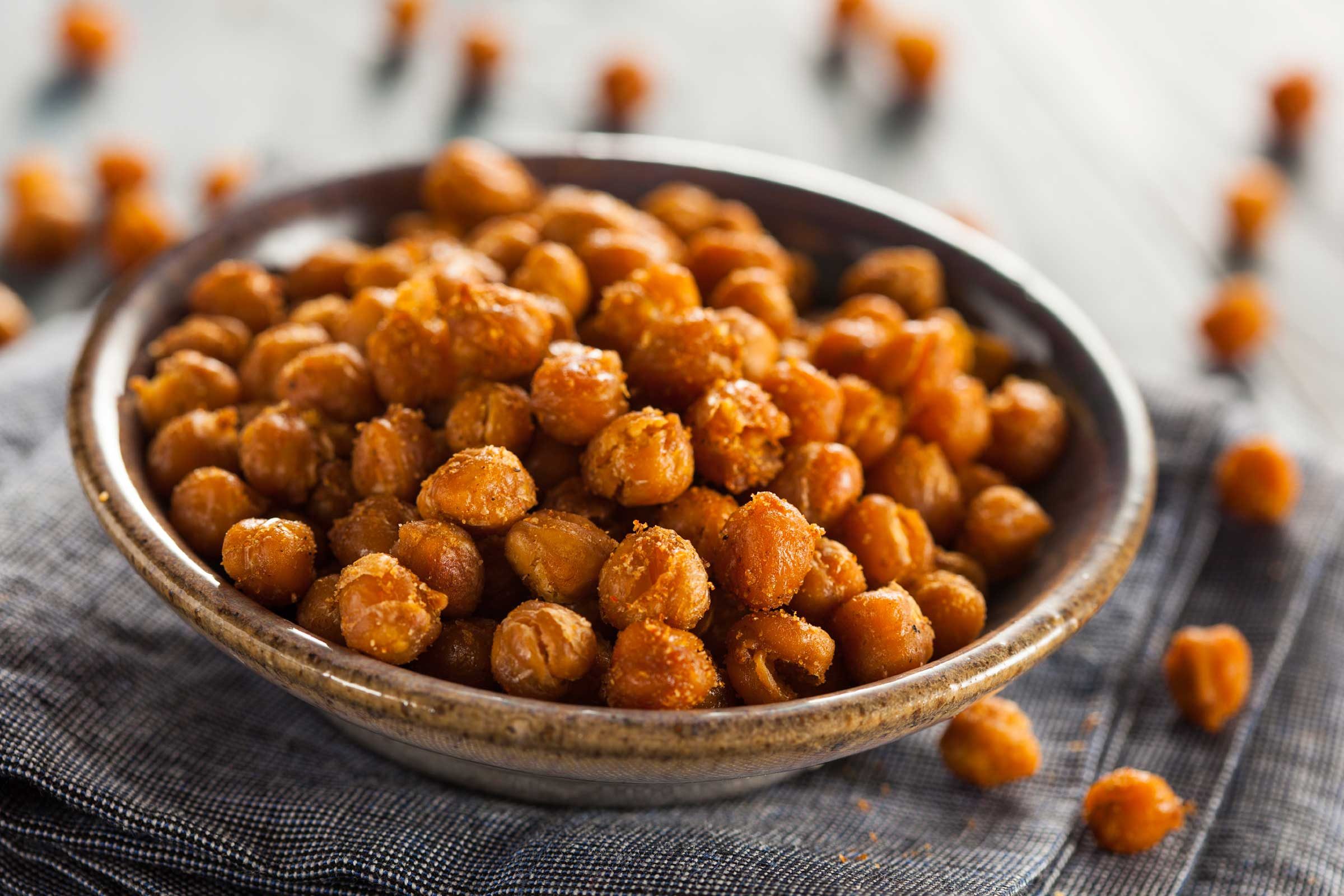
We’ve all had those days where a meeting runs way too long and you don’t have time to grab lunch. Your best bet to prevent a “hangry” (hunger + angry) episode: Rely on fiber-filled, protein-packed snacks that will keep you satisfied on relatively few calories, suggests Lakatos. Keep non-perishable snacks in your office drawer, like pre-portioned nut packs, or lower-sugar granola bars like KIND bars, roasted chickpeas, whole grain crackers, and even a small jar of peanut butter or almond butter. If you have access to an office fridge, stash these nutritious foods: apples, edamame, black bean dip or hummus for your crackers, non-fat yogurt topped with one tablespoon of granola, cucumber slices with low-fat cottage cheese, and raw, sliced veggies like carrots, peppers, and celery. We love these 31 healthy snacks for adults.

Drink plenty of naturally flavored water 


Flatten your belly by sipping water infusions throughout the day. The extra flavor will help if you’re sick of plain water and the combination of water and potassium from the fruit/herb/veggie infusions can help flush bloating culprits (like salt) from your system. Consider buying an infuser water bottle for your desk to which you add fruit or fresh herbs (find some on Amazon, Walmart, or Bed Bath & Beyond, to name a few). “When you’re properly hydrated you won’t make the common mistake of confusing thirst for hunger,” says Lakatos. “The extra fluid in your stomach can keep you feeling full.” The Nutrition Twins have a few favorite infusion recipes from their website: including Cucumber-Blueberry Water (8 ounces water, ¼ cup blueberries, ¼ cucumber, sliced), or their Lemon and Mint Detox Infusion that you can sip warm or cool (1 teaspoon grated ginger, slice up one lemon, several mint leaves, pour over 8 or 12 ounces water). These sneaky signs of dehydration mean you need to drink up.
Sip tea with lunch

Sip tea with lunch


Green, black, and oolong tea contain the amino acid theanine, which brings on a state of mental calmness yet alertness. This may help ease anxiety and prevent overeating due to emotional stress, while also making you very alert and mindful of your food choices. When you make good, healthy, rational meal decisions you stay leaner. These health benefits of tea are pretty mind-blowing.

Desk exercise: Zip up your abs


“We rely on this and it truly makes a huge flat-belly difference,” says Lakatos. Activate your abs by squeezing them in tight and pulling them back against your spine as you exhale. Picture zipping your abs together by using your muscles to contract your abs by pulling in from the center—think about pulling everything in a vertical line from your belly button up to between your breastbone, while also holding everything in and back toward your spine. Hold for a count of 10 as you continue to exhale. Slowly release and repeat for 10 reps at least three times. “Not only will this create good posture, it will also wake up the abs muscles and make it easier to keep your abs in,” says Lakatos Shames. Bonus: When you’re focusing on flat abs and a tight stomach you’re less likely to overeat at your desk. Here are 12 reasons your belly might be bloated.

Desk exercise: Tone your thighs


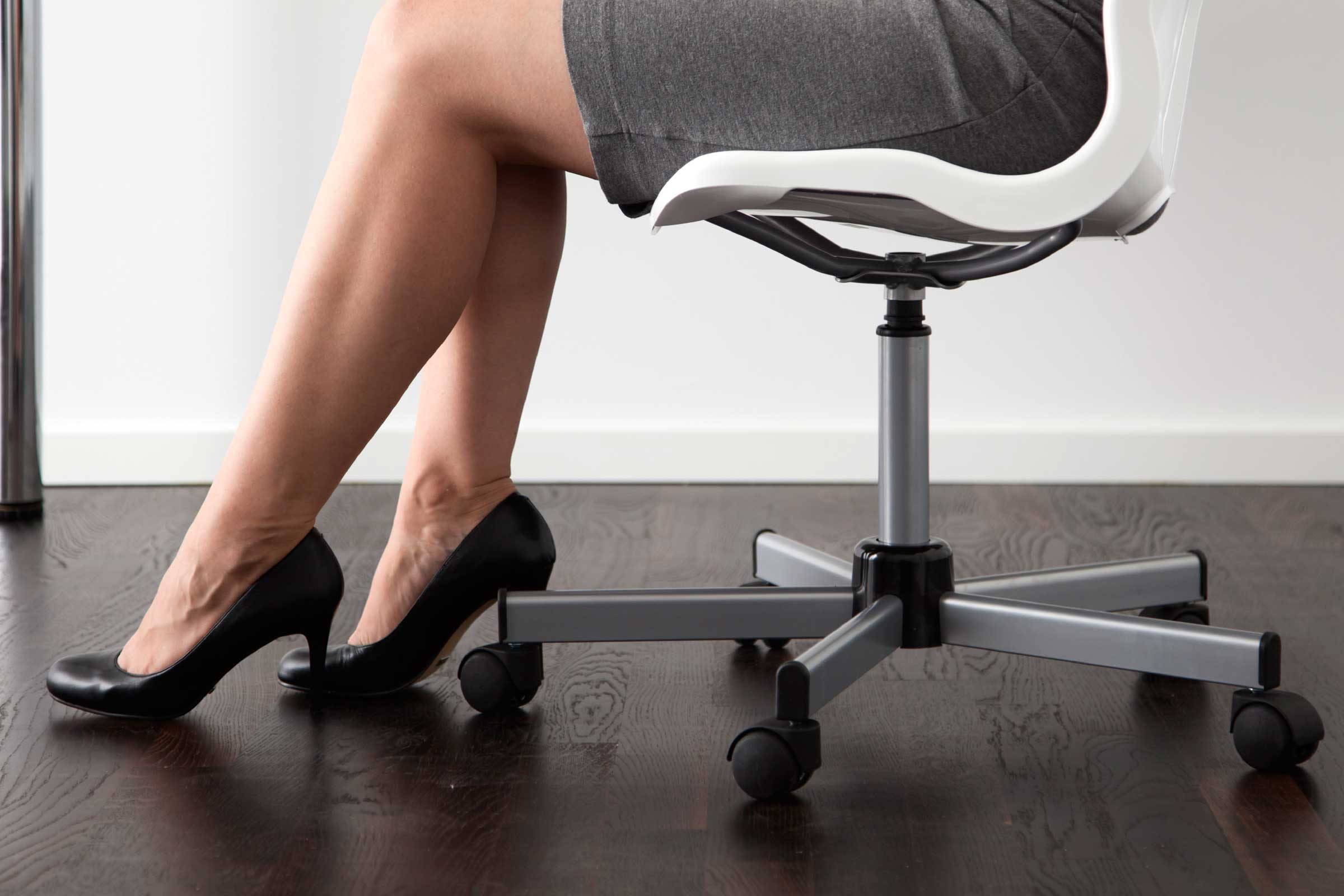
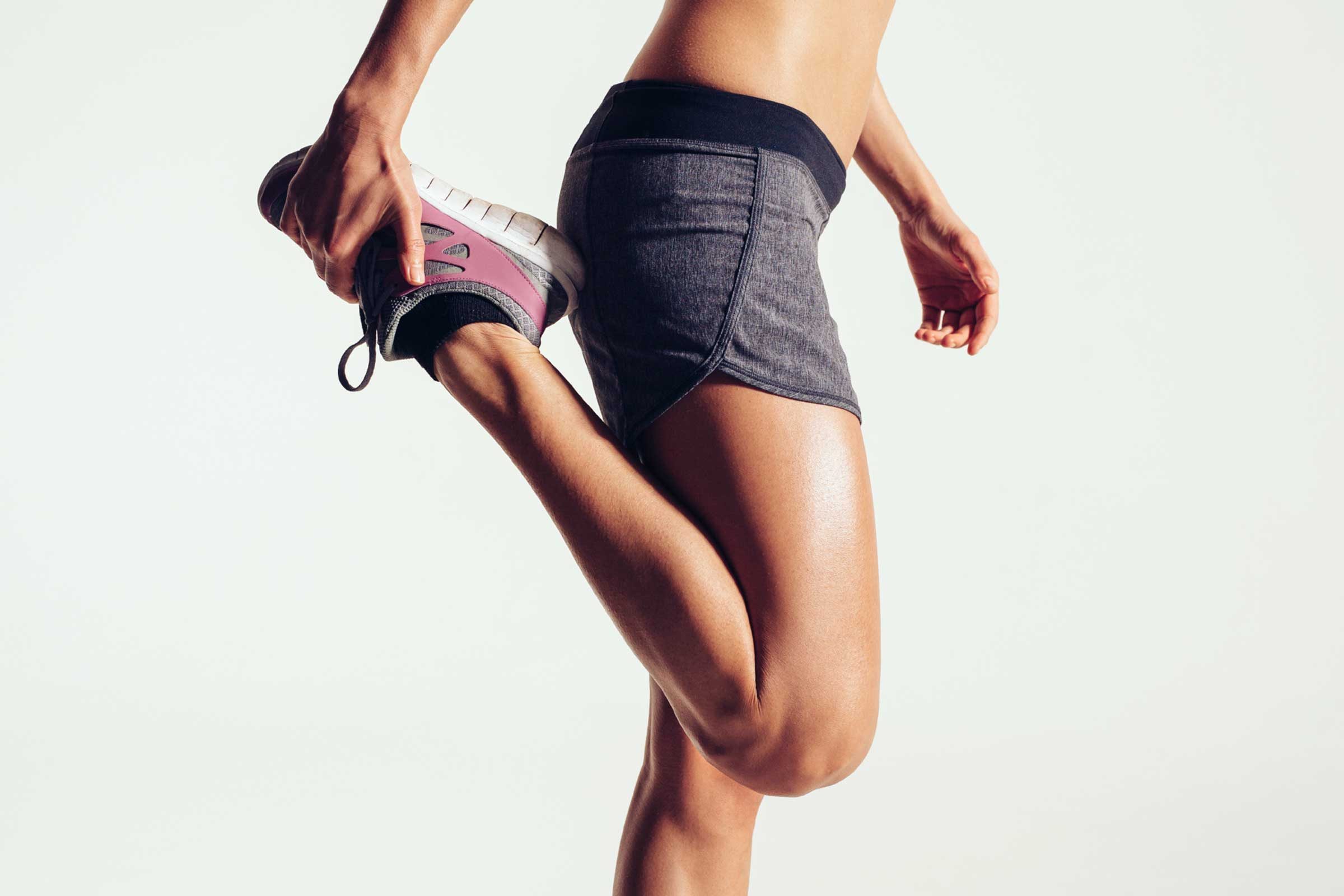
Try this thigh-toning exercise under your desk. (Beware wires and remove clutter first!) Stay seated with your feet on floor and back straight. Extend your right leg until it’s level with your hip, slowly lower. Repeat 10-15 times. Switch legs. You’ll feel the burn in your quadriceps.

Desk exercise: Strengthen your calves 


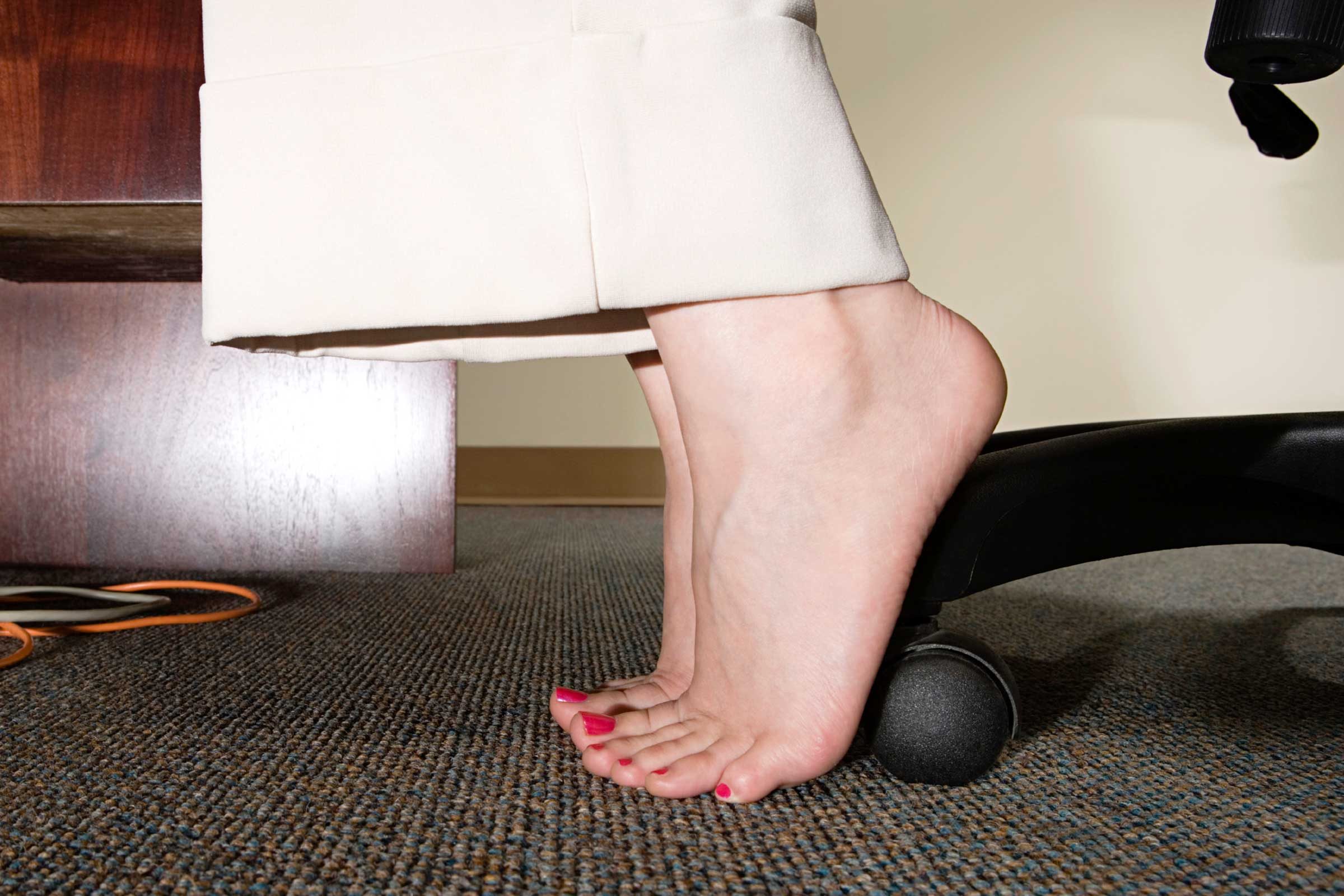
You can do this office exercise when you’re on the phone or doing something that doesn’t require you to write or participate beyond talking. Stand behind your chair, holding onto the back. Rest your right foot on back of your left lower leg. Do toe raises on your left foot. Switch sides. (If you’re in heels, remove them first.)

Desk exercise: Tighten and tone your butt 


Tense up gluteal muscles as you sit in your chair. Hold for 10 seconds. Do reps of 10 at a time. No one has to know you’re doing them.


Desk exercise: Jump-start digestion


Make your stomach flatter with this digestion exercise to stimulate peristalsis, the wave-like muscle contractions that move food through the digestive tract. Suck in your stomach as far as you can, then stick it out as far as you can. Breathe in when sucking in and breathe out when you push your stomach out. This small exercise helps blood flow to the stomach, aids in digestion, and exercises your abdominal muscles, says Lakatos Shames.

SOURCE BY : http://www.rd.com/health/diet-weight-loss/lose-weight-desk-exercises/

Wednesday, April 13, 2016

10 Lies About The Atkins Diet!

You'll discover the real truth about low carb diets and a real solution to the problem of excess body fat that is beautiful in its simplicity, yet powerful in effectiveness. Read on to learn the 10 Lies about the Atkins diet and discover the truth!

Low carbohydrate diets such as Atkins have always been controversial, but with the recent wave of new research and publicity, the controversy is now raging hotter than ever. One headline in the San Francisco Chronicle said that the battle between the low and high carbers had become so heated since mid 2002 that "Knives had been drawn."

From my vantage point (as a health and fitness professional down in the trenches), it looks more like tanks, artillery and machine guns have been drawn! Tragically, the people being hurt the most by these "diet wars" are not the experts, but the dieters.

After its original publication in 1972, The Atkins Diet was regurgitated in 1992 as "Dr. Atkins New Diet Revolution," creating a new surge of interest in low carbohydrate dieting.


Then, in July of 2002, the controversy reached an all time high when the New York Times Magazine published an essay by Gary Taubes titled, "What if it's all been a big fat lie?" The article suggested that new research was now proving the late Dr. Atkins had been right all along.

More research in 2003 seemed to corroborate the Taubes story: Two studies in the New England Journal of Medicine in May of 2003, and another in June 2003 in the Journal of Clinical Endocrinology and Metabolism, suggested that Atkins was equally, if not more effective for weight loss than conventional diets - at least in the short term.

With the publication of this new information, Atkins supporters boasted, "See, I told you so," while their opponents fired back in defense of their high carb, low fat positions. Meanwhile, low carb foods and supplements became all the rage, bread and pasta sales took a nosedive and the wheat industry cried the blues.

With differences in opinion as opposite as the North and South Poles, it's become unbearably confusing and frustrating to know which weight loss method is best and safest. At the date of this writing, in late 2003, obesity has reached an all time high -AGAIN!

According to the Journal of the American Medical Association, 64% of Americans are overweight and 31% are obese, and it's still getting worse.

Obviously, the popular weight loss methods today - including the low carb diet - are still missing something? But what?

If you're confused by the whole high carb, low carb thing and if you're frustrated with your attempts at trying to lose weight and keep it off, then this may be the most important report you will ever read.

In the next few minutes, you'll discover the real truth about low carb diets and a real solution to the problem of excess body fat that is beautiful in its simplicity, yet powerful in effectiveness. Read on to learn the 10 Lies about the Atkins diet and the truth that will set you free?

LIE 1 /// THE ATKINS AND OTHER LOW CARB DIETS DON'T WORK

If your definition of what "works" is quick weight loss, then the Atkins Diet DOES work. Recent studies showed that the Atkins Diet causes greater weight loss than the American Heart Association-recommended high carb, low fat diet.

In fact, for obese people with disorders of carbohydrate metabolism (hyperinsulinemia, hypoglycemia, and insulin resistance), Atkins-style diets have been shown to work especially well.

However, if your definition of what "works" is permanent fat loss, then the Atkins diet doesn't fare so well... but then again neither do any other diets. It seems that despite some encouraging initial successes, Atkin's dieters still face the same difficulties in keeping off the weight as everyone else.

Some of the same studies showing rapid weight loss on Atkins in the beginning also showed substantial weight gain as soon as the diets ended.

Truth is, a growing body of evidence is mounting that carbohydrate restriction can accelerate weight loss in the short term, but it has yet to be proven that it keeps the fat off in the long run.

Which approach towards low carb dieting is best is also up for debate: Not all low carb diets are high fat or ketogenic and not all are "ultra-low" in carbs. A low carb diet can be low in carbs and high in fat, it can be low in carbs and high in protein, or it can be somewhere in the middle.

I predict that continued research will discover that moderate carbohydrate restriction (especially in a cyclical fashion) and careful selection of carbohydrates, will in fact assist with fat loss via hormonal control, metabolic efficiency and appetite regulation.

I believe that neither extreme - the severely restricted low carb diet (ketogenic diet) or the very high carb, low fat diet - will emerge the victor.

LIE 2 /// THERE'S A TON OF NEW RESEARCH PROVING THE ATKINS DIET IS EFFECTIVE

If you surf around the Internet for a while searching for "Atkins Diet," you are likely to see a lot of advertisements and news briefs pointing to the new research "proving" that Atkins is effective.

"New England Journal of Medicine Vindicates Atkins diet."

"Studies suggest Atkins diet is safe."

"New research challenges 30 years of Nutritional Dogma."

Truth is, these headlines are not giving you the full picture.

Until and unless you have closely examined these studies and the researcher's interpretation of the results, don't be so quick to believe the diet hearsay and gossip.

The general conclusion of nearly all these studies is that Atkins IS equally if not more effective for short term weight loss than conventional diets. However, nearly all the researchers also conclude with remarks such as:

"The results are very preliminary,"
"The take-home message is that this diet deserves further study."
"More research is needed."

Furthermore, consider what the Atkin's diet was being compared to in these studies: The traditional "food pyramid" diet with 60-65% carbs including plenty of pasta, cereals and bread, right?

What if the traditional high carb diet is wrong too?

Don't write off carb restriction completely, but don't ditch all your carbs yet either?

LIE 3 /// THE NEW STUDIES PROVE THAT THE ATKINS DIET IS HEALTHY AND DOESN'T RAISE CHOLESTEROL AS PREVIOUSLY BELIEVED

In a May of 2003, the results of a 12-month study on the Atkins diet were reported in the New England Journal of Medicine (NEJM). One group followed the traditional food pyramid with 60% of the calories from carbohydrates while the second group followed the Atkins diet.

After one year, Atkins participants had a greater increase in the good HDL cholesterol and a larger drop in triglyceride than the high carb group.

The leader of the study, Gary Foster said, "Our initial findings suggest that low carb diets may not have the adverse effects we anticipated."

Conventional wisdom has dictated for years that saturated fat and cholesterol were dangerous and unhealthy, contributing to coronary heart disease. This led most health professionals to condemn low carb diets that allowed large amounts of saturated fat.

This belief is now being questioned. Many authors such as Mary Enig and Uffe Rashnkov have presented compelling cases that dietary cholesterol and saturated fat do not cause heart disease. The latest research seems to confirm this. However, many factors affected the results of these new studies.

In some studies, the subjects did not follow the Atkins Diet to exact specifications and never entered ketosis, so conclusions about saturated fat, dietary cholesterol, ketosis and coronary health cannot be drawn yet.

In other studies, cholesterol-lowering drugs were used. And in still others, some subjects actually showed increases in total cholesterol. Those who did show improvements may have previously been on a high refined sugar, high saturated fat diet and dropping the sugar was one step in the right direction.

Furthermore, some of the drop in blood cholesterol could be attributed to the decrease in body weight.

Clearly, you can't lump all dietary fats into the same category. Processed and chemically altered trans fats have been condemned by virtually every health and nutrition expert on the planet.

Other fats, like salmon and fatty fish, are among the healthiest and cardio-protective foods you can eat. Much evidence is showing that reasonable amounts of naturally occurring saturated fats such as those found in whole eggs and red meat also need not be feared (especially in the absence of sugars).

Truth is, all the information we have available at this time indicates the "fat phobia" and "fat makes you fat" scare has been unfounded because not all fat is the same. However, claims that diets very high in overall and saturated fat are healthy and safe for long term use are still premature.

LIE 4 /// THE ATKINS DIET WILL HELP YOU KEEP FAT OFF FOR GOOD

Dr. Atkins writes that his diet "Is so perfectly adapted to use as a lifetime diet that, unlike most diets, the weight won't come back."

It's a weight loss axiom that the more extreme a diet and the faster the weight loss, the more difficult it usually is to maintain the results. Slow, steady and balanced seems to win the race when it comes to weight control.

Unfortunately this isn't what most people want to hear. The four pounds per week and up to 15 pounds in the first two weeks that Atkins promises sounds much more impressive.

There are two things you really need to know about rapid weight loss:

What kind of weight was lost? How much of it was body fat and how much was water, glycogen and lean tissue?
Are you going to keep the weight off for good?
Most low carbers won't keep the weight off for more than a year, and many will fall off the wagon long before that.

Keith Ayoob, a spokesperson for the American Dietetic Association, said in an official ADA statement about the 2003 NEJM studies: "Twelve months is an equalizer; you hit a wall. Your lifestyle starts to be affected and you get bored. A high dropout rate is a sign that extreme diets can be difficult to maintain.

Truth is, despite Dr. Atkin's claims and the new research apparently supporting them, we still don't know what will happen in the long run. Based on the results of the recent three, six, and twelve month studies, researchers have begun to organize longer trials. One of them will be five years in length.

What I believe you will see in long term studies is that Atkins and other low carb diets, while effective for weight loss in the short term, will be found no more effective for long term fat loss than any other restrictive diet (and that's NOT very effective).

LIE 5 /// CALORIES DON'T COUNT AND YOU CAN EAT AS MUCH AS YOU WANT WHILE ON THE ATKINS DIET

Dr. Atkins proposed that calories don't count and he advised his clients to eat as much as they want while on his program. Atkins wrote, "The so called calorie theory has been a millstone around the necks of dieters and a miserable and malign influence on their efforts to lose."

Here's the truth about calories and low carb diets:

When you go on a very low carb (ketogenic) diet with more fat, your appetite is diminished and you feel fuller (because fat is more satiating than carbs).

Appetite control may be a legitimate benefit of the Atkins diet, especially for individuals who struggle with hypoglycemia, hunger and cravings. As Dr. Atkins points out, "Our physical urges are hard to combat."

However, this does not mean you can eat as much as you want. It means that your hunger may be blunted on Atkin's plan, causing you to automatically eat less without counting calories or even thinking about calories.

People on the Atkins diet who lose weight are not eating more than they burn and losing fat in spite of it. Whether you count calories and consciously eat fewer than you burn, or you don't count them and unconsciously eat fewer than you burn, either way, the end result is the same.

While counting calories in the literal sense is clearly not always necessary, you always have to be aware of calories and portions. No diet or special combination of foods can override the law of calorie balance.

Anyone who believes that you can eat as much as you want and still lose weight is living in a dream world.

LIE 6 /// A BRAND NEW STUDY JUST PROVED THAT THE ATKINS DIET GIVES YOU A METABOLIC ADVANTAGE SO YOU REALLY CAN EAT AS MUCH AS YOU WANT

A 12 week study conducted by the Harvard School of Public Health and presented in October 2003 to the North American Association for the Study of Obesity found that subjects on a low carb regimen lost just as much weight as those on a standard high carb, low fat diet.

The shocking part was that the group on the Atkins diet could eat 300 more calories than the group eating the conventional high carb food pyramid diet. This left researchers scratching their heads saying:

"It doesn't make sense? it defies the laws of thermodynamics."

"A lot of our assumptions about a calorie is a calorie are being challenged,"

Unfortunately, some of the Atkins troops were quick to interpret the results as meaning, "See, I told you calories don't count."

Actually, calories do count and the explanation for these results is quite simple.

A calorie is NOT just a calorie. If all calories were created equal then a 2000 calorie diet of Krispy Creme doughnuts would have the same effect as a 2000 calorie diet of chicken breast and salad vegetables. Do you think these two diets will have the same effects on your health and body composition?

Certain foods and certain diets DO give you a metabolic advantage. One advantage is the effect of a diet's composition on your hormones; namely insulin and glucagon.

A second advantage is called the thermic effect of food. The thermic effect of food means that a certain number of calories are used just to digest and absorb the food, leaving a net calorie value substantially less than the total amount of caloric energy that was contained in the food.

For example, a lean protein food such as chicken breast has a thermic effect of around 20-30%. This means that for every 100 calories of chicken breast consumed, the NET energy utilized by the body is only 70-80 calories. (Some people call this "negative calories.")

Stated differently, this means you really CAN lose weight on a higher calorie intake if you eat foods with a high thermic effect.

What's especially interesting -providing confirmation of the metabolic advantage of a high protein diet - is that the foods provided in this study were low carb, but NOT typical Atkins fare. Instead of lots of red meat and saturated fat, the subjects in this particular study ate mostly fish, chicken, salads, vegetables and unsaturated oils.

I think the study's director, Penelope Green, hit the nail on the head when she said, "Maybe they (the low carb, high protein group) burned up more calories digesting their food."

Truth is, not one study has ever proven that you can "eat as much as you want" on Atkins or any diet. Even when a diet provides a metabolic advantage, AFTER that advantage is factored in and you look at NET calorie utilization, you are still left with the calories in versus calories out equation.


LIE 7 /// THE ATKINS DIET CAUSES FASTER AND GREATER FAT LOSS THAN CONVENTIONAL DIETS

Most health, medical and nutrition organizations recommend that you lose weight (body fat) at a rate of no more than 2 pounds per week. In his book, Dr. Atkins says that the average weight loss in the first two weeks on his plan is 8 to 15 pounds.

Like many diets, Atkins overstresses total weight loss (and quick weight loss), while not stressing enough the difference between body weight, body water, body fat and lean body mass.

Truth is, low carb diets definitely cause greater weight loss, especially in the initial phases. But this is mostly due to a large drop in water weight and glycogen (stored carbohydrate), not necessarily increased fat loss.

Weight loss is the wrong goal! Your goal should be permanent fat loss and you should be measuring and tracking your body fat percentage and lean body mass on a regular basis.

Don't gloat over large, rapid "weight losses"? it might be mostly water and muscle.

LEE 8 /// CARBOHYDRATES MAKE YOU FAT

Dr. Atkins wrote, and I quote, "Carbohydrates are the very food that makes you fat." He also wrote, "Diets high in carbohydrates are precisely what most overweight people don't need and can't become slim on."

These are very misleading statements of half-truth.

The "carbs make you fat" myth is probably the most pervasive and damaging lie about weight control ever told. It's caused tremendous confusion and frustration to already confused and frustrated dieters.

First, focusing primarily on any macronutrient (protein, carbs or fat) or macronutrient ratio should be secondary to energy balance. What makes you fat is eating too many calories.

Truth is, you can't blame all "carbohydrates" as a group for why we are getting fatter. What type of carbohydrates are we talking about? There are good carbs and bad carbs. The "bad" carbs are the refined ones; white flour and white sugar products like white bread, white pasta, sugar sweetened cereals, candy and soft drinks.

To avoid confusion, I would suggest never using the word "carbohydrate" without putting the adjective "refined" or "natural" in front of it.

Ironically, Dr. Atkins does make this distinction in his book, yet he still chose to recommend removal of almost ALL carbs during the induction and weight loss phases of his diet - even the good carbs that are proven healthy. This creates rapid weight loss and the appearance of a hugely successful diet right from the first week.

Again, the real questions are: What kind of weight was lost and can you keep the weight off for good?

A healthy, maintainable fat burning diet should be centered on natural foods - and for most people, that includes natural carbs in moderation - not the total removal and demonizing of all carbohydrates.

LIE 9 /// KETOSIS MAKES YOU FEEL BETTER AND DOESN'T AFFECT YOUR PERFORMANCE

Your body is a remarkable machine that is fully capable of adapting to whatever fuel is provided in predominance. You can burn protein, fat, or carbs for energy. However, carbohydrates are your body's preferred - and most efficient - fuel source for vigorous physical activity.

Many low carbers believe that fat is a more efficient energy source than carbohydrates, but this is not true. Fat is not a more efficient energy source, it is only a more concentrated energy source.

Since the fuel for muscular contraction is carbs (glycogen) a high fat, low carb diet is not the best approach to fat loss for athletes, bodybuilders or highly active individuals. These diets simply don't support high intensity training.

Very low carb diets might be appropriate for the sedentary, severely overweight, or those with orthopedic conditions that prevent any exercise. It seems that ketogenic diets take off weight even with little or no exercise (although the weight won't be pure fat and you may not keep it off).

Some Atkins dieters even report feeling more energetic after adapting to the low carbs and higher fat. It's likely, however, that most of them were relatively inactive. Low carbs and high activity don't go well together.

Truth is, a more balanced diet of natural foods combined with exercise is a much better way to take off pure fat for good.

Anyone who CAN exercise SHOULD exercise! Of the two methods for creating a calorie deficit - burning more, or eating less - the former is the superior method with far fewer downsides.

Any fat loss program that does not make exercise the centerpiece is ultimately destined for failure.

LIE 10 /// KETOGENIC DIETS (VERY LOW CARB) ARE THE SECRET TO FAT LOSS

The term "low carb" is used very broadly. To some, a diet like the Zone, which consists of 40% carbs is "low carbs." To others "low carb" is more extreme. A ketogenic diet is a VERY low carb diet, usually between 40-70 grams of carbs per day or less. The induction phase of the Atkins diet is limited to only 20 grams per day.

Because they allow virtually no carbohydrate, Ketogenic diets, by definition, are extremely strict and nutritionally unbalanced. It's an irrevocable law that the more "extreme" a nutrition program is, the greater the side effects will be and the more difficult the diet will be to stay on.

Dr. Atkins claimed, "Ketosis is the secret weapon of super effective dieting."

Truth is, while some recent studies have suggested low carb diets do work, not a single study has proven that it's necessary to restrict carbs so severely that you go into ketosis.

The benefits of reduced carbs and more protein include a higher thermic effect, appetite regulation and hormonal control. What the low carb folks don't want you to know is that a moderate reduction in carbohydrates (and/or removal of processed carbs) is often all it takes to get these benefits, while being much easier to maintain for the long haul.

WHAT IS THE BEST WAY TO ACHIEVE PERMANENT FAT LOSS?

Dr Atkins made many excellent points about weight control in his book. He spoke out on the evils of processed carbohydrates. He identified carbohydrate sensitivity and hyperinsulinemia as contributing factors in obesity.

He spoke of the metabolic advantage of high protein. He pointed out that there may not be a direct one to one correlation between saturated fat, dietary cholesterol and heart disease.

The fact is, Dr. Atkins - to his credit - had discovered some important facts about weight control, and had the courage to publish and stand by them long before anyone else did. In the end, unfortunately, he drew some questionable conclusions from this information and, like so many other diet gurus, he left out some large and important pieces to the puzzle.

If permanent fat loss were as simple as removing carbohydrates from your diet, then why has obesity surged to an all-new high in 2003 and why are there so many Atkins failures?

Could it be possible that the conventional high carb, low fat food pyramid approach and the Atkins diet approach have BOTH missed the mark, and that the optimum diet for permanent fat loss is somewhere in the middle?

Could it be possible that dieting is the absolute worst way to lose body fat and that the proper type of exercise program combined with a more balanced approach to nutrition is the answer?

One of the biggest errors weight loss seekers make today is to accept one philosophy completely or reject it completely, taking a side and "taking up arms" to defend their position without considering the alternatives.

Most of the weight loss philosophies being promoted today contain valid points, but as a whole, are a total mish mash of truth, half-truths and lies.

That's why, for over 20 years, I have literally turned myself into a human guinea pig in my search for a sensible and healthy method of permanent fat loss. I studied and then personally tested the ketogenic diet, the high carb diet, low fat diet and nearly every other diet in between.

I found good points and bad points in all of them, many of which I have already revealed to you in this report.

I then compiled all the positive points of each fat loss method into a structured format, while discarding all the negatives. What emerged was nothing short of remarkable: An all-natural system that has allowed me to peak at a body fat level of 3.4% and to maintain my body fat at 9% or less all year round? without drugs, extreme diets, or unnecessary supplements. It's worked for thousands of other people too.

If you would like to learn exactly what I discovered about permanent, natural fat loss from two decades of study and experimentation... and if you'd like to learn how it can help you escape the diet wars for good, and finally achieve the body you've always wanted, I encourage you to visit my fat loss web page at www.burnthefat.com and take a look for yourself.

SOURCE BY : http://www.bodybuilding.com/fun/venuto1.htm

Monday, April 11, 2016

A Beginner's Guide To Healthy Fat Loss

You're ready to lose weight, but overwhelmed by complicated diet plans. Learn how to achieve your goals by focusing on what's absolutely necessary!

You may have heard some variation of this statement before: Your commitment to improved nutrition has to be a total, sustainable lifestyle change.

When people say this, they're often doing it with the best of intentions. They're trying to make eating better seem easier and more approachable. But what comes across is often the opposite. After all, there are an infinite number of nutrition-related variables you could change, and they would all impact your enjoyment, progress, and willingness to continue.

So let's break it down and focus on doing fewer things better. Here are four techniques you can use to make real progress without getting overwhelmed.


1.DON'T MICROMANAGE YOUR MACROS

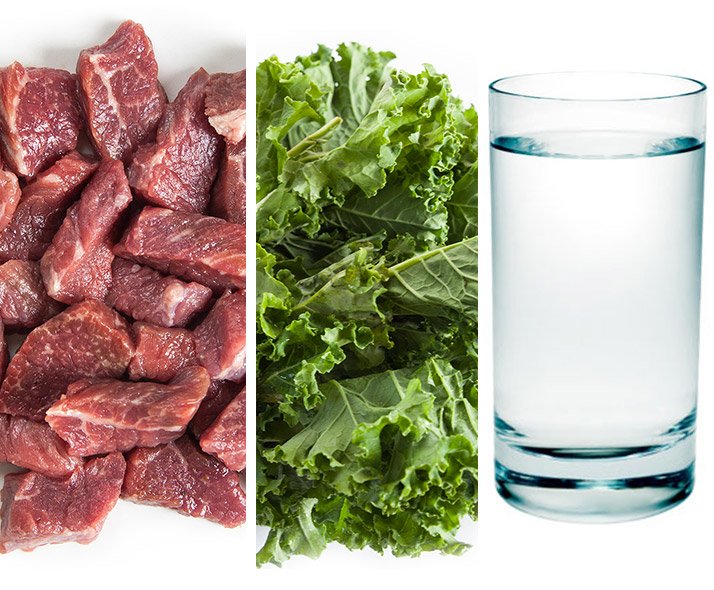
Repeat after me: protein, vegetables, water. If you forget everything else after reading this article, at least remember these three words. They're the nutritional foundation of fat loss.

Don't get me wrong—fat has its place, and it's an important one. But if your goal is to lose weight, eating more protein and vegetables and drinking more water are the priorities. Focus on getting more of all three, and you can solve a lot of problems.


Why? Let's break them down one at a time.

Protein: Aside from its ability to help you add muscle—which, in turn, helps to burn more fat—protein has several other benefits. It is slow to digest, which can help keep you feeling full throughout the day. It also has a high thermic effect, which means your body actually has to burn energy to digest and absorb protein. Yes, you understood that correctly: Protein can help keep you feeling fuller while eating less. To keep calories in check and encourage muscle-building at its highest, I recommend using lean animal proteins a majority of the time.

Veggies: After you're finished pummeling your protein, it's time to feast on veggies! Aside from the nutrient density and abundant antioxidants most vegetables have to offer, they also help to promote fullness due to their high water content. Fresh, frozen, or canned, each offers few calories per serving, which leads to larger portions and more fullness without the caloric overload or guilt trip.

SYMPTOMS OF DEHYDRATION

  • Hunger
  • Fatigue
  • Headaches
  • Lightheadedness
  • Trouble focusing
  • Irritability
  • Impaired short-term memory
  • Muscle cramps
  • Decreased speed and strength
  • Impaired reaction time
  • Symptoms can appear when you're dehydrated by as little as 3%!1,2


Water: With all of the hoopla around macronutrients, it's easy to forget that water is an essential nutrient, too. After all, we're at least 70 percent water, which means we're more water than protein! Aside from the cognitive and performance benefits associated with proper hydration, it's crucial to drink water consistently throughout the day to further promote fullness, prevent dehydration, and boost recovery from exercise. Of course, this calorie-free fluid also takes up ample space in your stomach, preventing you from trying to fill it with candy and cookies.

These priorities can even extend to the order in which you eat things on your plate. Try filling up on proteins and veggies first, with ample sips of water throughout the meal. If you still have room afterward, that's when to eat your carbs and fats.

2.FIX ONE MEAL AT A TIME

Look at some fitness-related Instagram feeds, and you might get the impression that you have to prep every meal every day to get results. You don't.

Identify the one meal that is the most troublesome for you each day. Maybe you often skip lunch because you're overloaded with meetings and projects all day, or you frequent the fast-food drive-thru for dinner on the reg. Maybe you still eat the breakfast of an overactive 6-year-old, and your wavering energy level throughout the day shows it. Tackle whatever meal gives you the most difficulty in consistently making sound nutritional choices.

First, make a plan. Plot out what you will eat for that specific meal each day of the week. Not just today, or tomorrow—every day of the week. If it's lunch or dinner, iron out your lean protein and vegetables (and carbohydrates, depending on the meal,) and decide which ones you will include in that meal. Maybe it's salmon and broccoli tomorrow, and grilled chicken with green beans the next.

Once you've got your foods picked, make the meal happen! Carve out the time to cook, portion, and pack the ingredients for this meal for the next few days. I'm not asking you to pack a week's worth of food, or even a day's worth—just one single meal per day.

If you can replace a few fast-food or vending-machine meals each week with some quality protein, vegetables, and water, that's a big step. You'll eliminate plenty of excess calories, improve your overall nutrition, and start building the habits that will lead to long-term progress.

3.LOOK FOR SIMPLE SWAPS

Steps 1 and 2 can be game-changers on their own, so by all means start there. Then, turn to the other caloric black holes that might be hiding in your life.

These don't always have to be attacked with the wholesale "replace a meal with a different meal" approach. Often, a simple ingredient swap can boost your intake of healthful nutrients while slashing fat and calories in half. You'd be surprised how effortlessly you can cut calories throughout your day. Here are a few places to start:

4.DON'T START TOO FAST

The biggest diet mistake is cutting calories too rapidly. This is because your metabolism is dynamic. It adapts to your current level of food intake and exercise, and it will respond to dramatic changes by trying to slow them down.

If you begin including regular exercise as well as reducing caloric intake by 1,000 or more calories per day, you will place your body in a rather large negative caloric balance. You're undoubtedly going to lose weight, and lose it fast. Initially, you may lose 2-5 pounds per week. However, this won't last.


Soon, your weight will plateau, and the next logical step is to further increase your treadmill time or to further reduce calories. But do this, and you'll only end up losing muscle and messing with your hunger-related hormones, both of which will do more harm than good to your results in the long term. It can also set you up for rapid weight gain when—not if—the hunger wins and you engage in an epic caloric splurge.

Losing 50 pounds isn't going to happen overnight, or in the next week, or even the next couple of months, and that's a good thing. That rate of loss wouldn't be sustainable, nor would it likely be healthy.

Here's what is healthy and sustainable: 1-2 pounds a week. Some weeks it will be more, some less. It probably won't be linear. But it's the rate to aim for, and it's how lasting change is achieved.

SOURCE BY : http://www.bodybuilding.com/fun/a-beginners-guide-to-healthy-fat-loss

Sunday, April 10, 2016

4 Tips For Sticking To Your Diet When Dining Out

Don't surrender your social life in an effort to eat clean. Learn how to navigate restaurant menus and stay on your diet while eating out!

Dieting doesn't have to mean skimping on romantic evenings out or losing time with family and friends. Instead of staying at home and missing out on a delicious restaurant meal, arm yourself with knowledge so you can be social and eat smart. Follow these four surefire tips to help you stick to your diet when dining out!

1.DON'T DRINK YOUR CALORIES

Cutting out soda, sweet tea, and alcohol is one of the simplest strategies to reduce overall calories when dieting. If you follow this tip at home, simply carry it with you to any restaurant meal. Choose calorie-free options such as water (bonus: this one is usually free!) or a diet beverage. Instead of blowing your calorie bank on liquids, save indulgences for the main course.


2.TAKE CONTROL OF YOUR MEAL

Too often, people are hesitant to speak up about their preferences when ordering at restaurants. Never feel obligated to accept a meal other than what you originally planned. While you might have to ask for off-menu replacements, you shouldn't settle for a meal that completely deviates from the one you planned. Take control of your meal using these simple methods:

PERSONALIZE PREPARATION METHODS

Restaurants are pretty good at offering low-fat cooking options such as baking, roasting, or grilling, but keep in mind that simply asking for something grilled may not be enough. Despite being grilled or roasted, steaks and fish are often cooked in butter—a noticeable flavor booster, but unnoticeable calorie-booster. Don't be afraid to ask the chef to hold the butter, skip the sauce, and bypass the oil so you can stay on track.

SKIP THE FREE OFFERINGS

Don't let the bread basket that greets you at the table be your downfall. Remember, snacking counts! Filling up on complimentary tortilla chips will still cost you calories. While it's easy to slowly nibble on these not-so-nutritious snacks, they disappear quickly, which can add unwanted calories fast. Take charge and simply inform your server ahead of time that you're not interested in the freebies. This will place the unnecessary calories out of reach.


MAKE THE MENU YOURS

Not digging the twice-baked-potato casserole that comes with the grilled sirloin? Maybe your mouth is watering over the quinoa salad served with the fresh catch of the day, but you're allergic to seafood. Rather than falling back to a simple grilled chicken breast and salad, speak up and ask the server specifically for what you want: the grilled sirloin and quinoa salad.

There's simply no reason why you shouldn't be able to order each item you want, even if what you're after isn't paired together on the menu. After all, the ingredients are sure to be on hand for both items. Take control of your meal and enjoy it.

3.EAT PROTEIN, VEGGIES, AND CARBS—IN THAT ORDER

You don't necessarily need to eat your macros in this order bite-for-bite, but you should focus primarily on consuming both your protein and vegetables before moving on to your carbohydrates.

Protein and high-fiber vegetables—sorry, mashed potatoes don't make the cut—help to slow down digestion, which leaves you feeling fuller, faster. By placing an emphasis on these two items from the start, you're less likely to overindulge in a creamy, sugary dessert because you're already full.

SUGARY DESSERT.

Your source of fat may come from your succulent steak, fresh vinaigrette, or even from sliced avocado. If you happen to have a healthy fat mixed in, go ahead and eat that in conjunction with the protein and veggies before thinking about crushing the carbs!

4.INSTILL PORTION CONTROL FROM THE START

From supersized and extra fries to all-you-can-eat extravaganzas, restaurants are quickly becoming patrons' favorite places, not only because of the dishes they serve, but because of the size of those dishes. Many people see it simply as "the bigger, the better." Sure, this nets you more bang for your buck, but if you're like many people and feel the urge to clean your plate(s), you're likely to hit your macros for the next three days all in one meal.

If you find yourself at a restaurant with oversized portions, request that a to-go box be brought out with your meal. This way, once your food arrives at the table, you can put away a portion for your next meal or two and focus on enjoying the amount at hand. Hey, it's like ordering two meals for the price of one!

SOURCE BY : http://www.bodybuilding.com/fun/4-tips-for-sticking-to-your-diet-when-dining-out

Tuesday, April 5, 2016

How to Eat Less, Move More & Lose Weight

To eat less and move more to lose weight may sound like stating the obvious.

But for most people to eat less, to move more and to lose weight all sound more like the impossible – goals they’ve been dreading.

After all, 2/3 of our population are overweight. How’s it possible to eat less when everyone around you is obviously eating more? And how can you move more when most people move less than a sloth?

Maybe now’s the time to learn how to eat less, move more and lose weight.

It’s certainly not something kids learn how to do in school (more like just the opposite) or are taught at home while growing up – and out!

Eat Less, Move More, Lose Weight

Although learning how to eat less, move more and lose weight permanently may be a challenge (at first), the health benefits are huge:
  • Feel better,
  • Be powerful,
  • Boost energy,
  • Improve health,
  • Prevent diabetes,
  • Control blood sugar,
  • Lower blood pressure,
  • Look more fit & glowing,
  • Slow down aging process,
  • Increase flexibility & balance,
  • Decrease risk of heart disease,
  • Live a longer more satisfying life.
Research shows that by eating fewer and healthier calories, you not only extend your life span, you also feel much better in the process.


How to Eat Less to Lose Weight


To learn how to eat less for permanent healthy weight loss, you must:

1.  Make a firm commitment. Commit to put in the time and management necessary to produce the results you want to achieve.

2.  Construct a foolproof plan. Design a new lifestyle you can live with. Set aside the time and gather all the necessary tools.

3.  Plan for counting calories. Whether it’s a weight loss journal or calculator, you need a system for adding up your food calories.

4.  Keep yourself motivated. Use goals, positive self-talk, visualization and rewards to motivate yourself and stop emotional eating.

5.  Be responsible for results. Give up blaming circumstances and other people and take full responsibility for getting what you want.

6.  Commit to health & fitness. List things you like to do other than eat and choose friends and activities to support a healthy lifestyle.

7.  Use any tricks that help you. Try these tips for how to eat less at home and when eating out at parties and restaurants.

How to Move More to Lose Weight


Studies show that those who do both aerobic exercise and weight training to lose weight, lose the most body fat, belly fat and waist fat.

1. Pick your time and place. Exercise requires time. To take it on, you need to choose how, when and where you’re going to exercise.

2. Start slowly and build up. If you haven’t been exercising or lifting, it’s essential that you don’t take on too much too fast.

3. Choose whatever works. Go for a walk, join a gym, hire a trainer or work out at home with a DVD and free weights – just do it!

4. Aim for 30 minutes a day. Do aerobics and weight training combined for at least a half-hour a day and up to an hour and a half.

5. Keep a progress record. Whether it’s tracking calories in a weight loss journal or checking off exercises on a chart, write it down!

Learning how to eat less, move more and lose weight for healthy permanent weight loss requires creating a new lifestyle and consistently making adjustments along the way. But it’s well worth the results.

Saturday, April 2, 2016

The Low Down on Body Fat


Most of us would be aware of BMI (Body Mass Index) as a tool used to measure an individuals healthy weight range relative to their height and gender. We’ve been advised to monitor our BMI and are encouraged to keep it in the healthy range and don’t allow it to creep into the over weight or obese categories.

The problem with BMI is that the scientific evidence suggests that it is not an accurate predictor of a health when it comes to ageing.

Most studies indicate that having a higher BMI as we get older is linked to a lower mortality rate. That’s right. Higher BMI, live longer.135,136

What’s going on and is there a better indicator for health?

A recent study from Canada followed more than 50,000 middle-aged and older Canadians and found that body fat percentage is a better predictor of life expectancy than BMI. Being on the thin side or having a low BMI didn’t protect against early death. The results supported previous studies that show that mortality rates increased as BMI decreased and body fat percentage went up.137

The researchers reported that both low levels of lean mass and high levels of body fat are independently associated with increased risk of death, and concluded that a direct measure of body fat is really the most accurate way to determine health in ageing.

Does that mean that all these BMI studies are telling us that being fat is healthy?


The reason for this apparent contradiction is you don’t have to be “fat” to have a high BMI. For example if I put my height and weight figures into a BMI calculator (this one from the Australian Heart Foundation) it tells me I’m 1kg from being “overweight”, yet my body fat percentage is 12% (I range between 9-13% depending on my training goal). The more likely explanation is that many of the high-BMI participants of these studies may have low body fat and high lean mass and subsequently any measure of health should place them in a "healthy" range, not a high risk range for mortality!


So what is body fat and how do we measure it?

If you weigh 100kgs, and 10 kgs of that is fat, then your body fat percentage is 10%. 15kgs of fat would put it at 15%, 20kgs at 20%, you get the idea.

If you gain or lose only fat, your body fat percentage goes up or down accordingly. But it can also go up without gaining fat, and down without losing fat.

How is that possible? IT'S ALL ABOUT YOUR MUSCLE


Let’s say you’re fairly muscular and weigh 90kgs with about 12kgs of that being fat. That puts you around 13% body fat ((12/90) x 100).  And if you were 185cm tall and male then your BMI would be 26 (Overweight range). If you stopped training (that is, lifting heavy weights) and lost 10kgs of muscle over the course of a year, without losing any fat, you now weigh 80kgs with the same 12kgs of fat. Your new body fat percentage is about 15% ((12/80) x 100) and your BMI (assuming you haven’t shrunk) is now 23 (Healthy range).

Of course we would all like to be going the other way, so let’s say you (the same 185cm male) weigh 85kgs and are carrying 10kgs of fat. Your body fat percentage is around 12% and your BMI is 24 (Healthy). If you gain 5kgs and little-to-no-fat, you’re now back to weighing 90kgs with the same 10kgs of fat, so your body fat percentage has now dropped to 11% but your BMI has gone back to 26 (Unhealthy).

It wouldn’t be one of my articles if I didn’t mention Age – Most calculations and images for determining body fat percentage  assume ages of around 25-35 years old. The reality is that there will  be higher body fat levels as your age increases. For example, a 20 year old man and a 50 year old man may have the same subcutaneous body fat measurement (fat under the skin), but the 20 year old may be 15% body fat and the 50 year old will be at 20%. Doesn’t sound fair, does it? As part of the ageing process, not only are we losing muscle (sarcopenia) but the fat around the organs (visceral) and within muscle (intramuscular) tends to increase.

While there is some debate as to what constitutes a “healthy” body fat range, there are some reasonable guidelines available.

Body Fat Percentage Chart

The chart below from the American Council on Exercise (ACE) is one of the most commonly used body fat charts.138 As you can see, women have a higher body fat percentage relative to men for a given level. Women have more fat because of physiological differences such as hormones, breasts, and sexual organs. In addition, women need a higher amount of body fat for ovulation.

Unless you’re a competitive bodybuilder and know exactly what you’re doing, I recommend you never try to reach the Essential Body Fat range. Organ failure can occur in this range, and it can only be maintained for a day or two. If you reach the athletic range, you’ll have a lean, ripped physique that the fitness enthusiasts like to achieve (this is where most six-packs kick in).

The limitation of this chart is that while it takes into account gender differences, it does not take into account your age, which is important for us over 40.

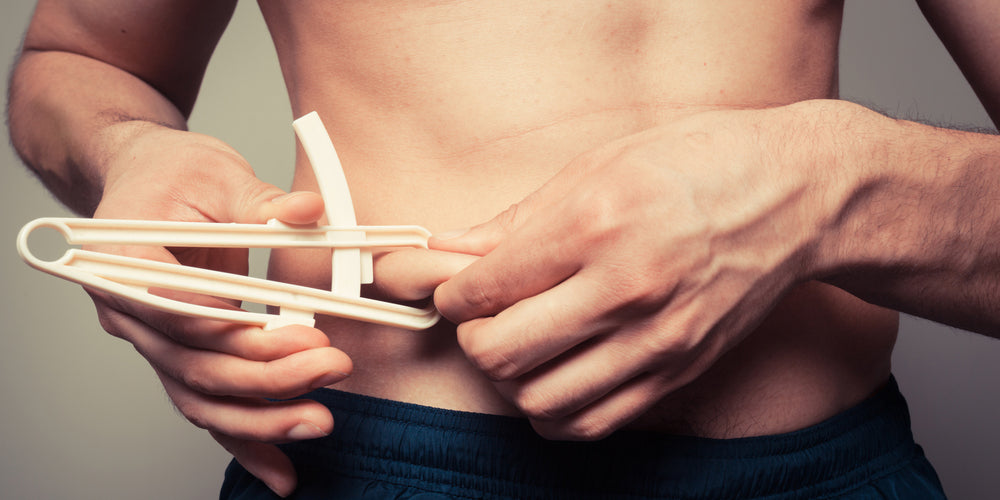
AccuFitness is the maker of the popular Accu-Measure Body Fat Caliper, which is a one-site skin-fold-body fat measurement method. When you buy the product, AccuFitness includes a body fat percentage chart based on research by Jackson & Pollock and because it utilises age based data (and I use the calliper), it’s the chart I prefer to use. (Full Chart here).139,140

So if you are a 45 year old woman, a body fat percentage of around 22.9% is considered ideal. (feeling better?)

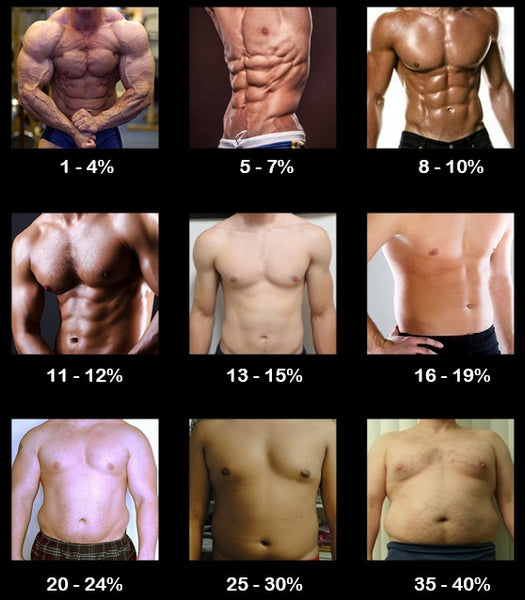
What will I look like?

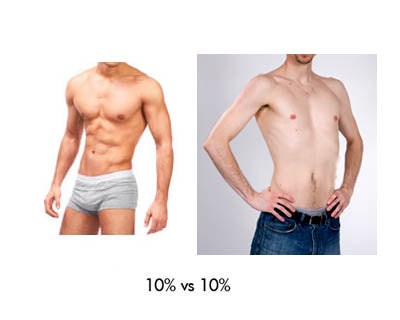
As you know, body fat percentage varies widely depending on how much muscle someone has.

10% body fat on a person with no muscle will look very different than 10% on a person with a lot of muscle, simply because the extra muscle fills out the physique and gives it some definition.

Here’s an example:

Despite the possible variations, the following images are accurate representations of various body fat percentages given the amount of muscle the men have.

As you’ll see, women look much leaner than men at higher body fat percentages. This is mainly because of the extra fat women naturally hold in their breasts, butt, and hips.

Most of these visuals are pretty accurate for the average woman, with the exception of the leanest categories (most women won’t have this much ab definition unless they’re veteran weightlifters).